
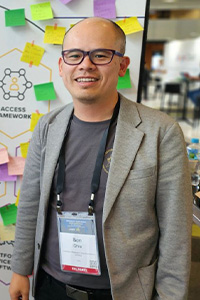
Orchestrating the future
Standing in front of an orchestra with over 80 players, Ben Chiu has only a few tools at his disposal. A baton. A score. The confidence of the musicians in front of him.
Yet somehow, dozens of individual performers come together to create a single, cohesive sound. It is a skill that has served him just as well away from the concert hall.
As Director, Services at the Australian Research Data Commons (ARDC), the Charles Sturt University graduate works across a network of universities, research organisations and government agencies that collectively support Australia's national digital research infrastructure to accelerate Australian research through the National Collaborative Research Infrastructure Strategy (NCRIS) program. The settings may be very different, but the challenge is familiar: bringing together people with diverse expertise and helping them work towards a common goal.
"If I had to summarise my lens, it’s as an orchestrator," Ben says.
"It's about identifying people's skills and strengths, looking at how they can be brought together and led in a way that really shows off their talents and generates positive outcomes for everyone."
But Ben never originally planned to work in the digital world. His kindergarten teacher discovered his musical talent when she found him on a keyboard playing “Mary Had a Little Lamb” after hearing it once, and this kickstarted a musical journey that led to studying music at the University of Melbourne’s Conservatorium during his high school years. However, this journey prematurely ended when Ben realised that the realities of pursuing a professional music career dampened his love for music and conducting.
Instead, drawing on his hobby of developing webpages during high school, he fell into a technology career that coincided with the dot-com boom of the late 1990s. While still studying, Ben was working on some of Australia's earliest e-commerce projects, supporting organisations such as Mazda, Boral and Home Hardware to establish their online presence at a time when many businesses were still figuring out what the internet might mean for them.
It was exciting and fast-moving work, but it also revealed something that would shape the next two decades of his career.
"Language and communication, no matter whether it’s technology or music, are so important," he says. "Often, people know what they want to achieve, but don't have the language or know-how to get there.
"I soon realised that no matter what organisation I worked for, part of my role was learning to translate a client's ideas into visible, usable outcomes."
That ability to move between technical and non-technical worlds became increasingly important as his career expanded across private, public and for-purpose organisations. Over time, however, Ben began looking beyond technical expertise. He wanted a deeper understanding of leadership, governance and decision-making to understand not just how decisions are made, but how they can shape organisations and society.
Charles Sturt provided that opportunity.
Studying remotely through Charles Sturt’s IT Master’s program, he completed a Graduate Certificate in Industry Computing in 2017 before graduating with a Master of Management (Information Technology) in 2019.
"What really appealed to me was the flexibility to do one or two or three subjects at a time so I could juggle it around my full-time workload," he says. "The course offered a real blend of leadership and governance topics alongside hands-on subjects with contemporary content that reflected the real world."
The impact extended beyond formal study.
"The Masters reinforced the importance of listening before leading," he says. "It helped me understand that good leaders test assumptions, seek evidence, ask the right questions and enable others to make good decisions."
Today, his work sits at the intersection of technology, research and public good. He leads services and capabilities used by Australian and international researchers tackling challenges that range from health and environmental sustainability to emerging technologies, including the creation and use of Artificial Intelligence (AI) models and its outputs. Despite the scale and complexity of the work, his focus rarely drifts far from the people involved.
"Digital technology, data and cybersecurity are important, but people are always the primary asset," he says. "My role is about helping bring together the right people, skills and capabilities so others can succeed."
The same philosophy informs his contributions beyond his professional role. As a board member of Sexual Health Victoria and a member of the National Artificial Intelligence Centre’s Responsible AI Think Tank, he is involved in conversations about ethics, governance and the responsible use of technology.
Artificial intelligence (AI), in particular, remains one of the defining challenges of the present moment. "There must be accountability and human oversight because, ultimately, AI is only as trustworthy as the underlying data, processes, and the humans behind it," he says.
For Ben, discussions about AI are less about technology than they are about judgement. As organisations race to adopt new tools and capabilities, he believes the human element remains critical.
"I think we as humans need to become comfortably uncomfortable with the fact that AI is absolutely here to stay and has the ability to improve humankind, if used appropriately," he says.
"But always cast a considered eye over how we choose to use AI.
"Because we need a balance between servicing our people without disadvantaging them in the process, particularly those in society who are already at risk of being left further behind."
Music offers its own reminder of that principle.
Two pieces of advice from a conducting mentor has remained with him for decades. "A really good orchestra chooses to follow a conductor," he says. And, “own your mistakes and learnings, because others can learn and benefit from them too.”
"I’ve made more than my fair share of mistakes both personally and professionally but being open and sharing the ups and downs with people is really important. Musically, that honesty helps to build that level of trust and mutual respect with the players, which allows great performances to happen. Audiences can feel, see and hear that level of respect and collaboration in the concert hall, but it takes time and being your authentic self to build that trust and connection."
Whether he is standing in front of musicians, contributing in a boardroom or helping shape Australia’s research infrastructure, Ben keeps returning to the same idea. Success rarely comes from one person. It comes from creating the conditions for others to perform at their best.
Careers, he says, are increasingly built across disciplines rather than within them.
"I see some of the biggest opportunities sitting between disciplines, so consider your skills rather than your specific industry when looking at opportunities," he says.
"One of my main mantras is depth, then breadth. Build depth in something you care passionately about, then develop the breadth to connect it with other areas and other people."
It is advice that reflects his own journey. Technology, governance, leadership and music may appear unrelated at first glance. In practice, each has relied on the same ability to bring talented people together and help them move in the same direction.
And, occasionally, to know when to simply listen.