
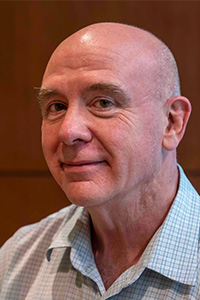
Bachelor of Applied Science (Medical Laboratory Science), 1994
From regional Australia to global health leader
From laboratories in regional Australia to leading infectious disease research across Southeast Asia, Professor Stuart Blacksell has spent more than three decades working to protect communities from emerging health threats and improve global public health. Today, his contributions are helping strengthen disease prevention, laboratory systems and health security around the world.
In recognition of his outstanding impact, Stuart has been named Charles Sturt University's 2026 Distinguished Alumnus of the Year for Research Excellence.
"Being recognised as a winner by Charles Sturt is both humbling and deeply meaningful," he said.
"My education at Charles Sturt provided the foundation for a career that has taken me from regional Australia to working with international organisations, governments and some of the best scientists and universities in the world."
Stuart's career began in microbiology and laboratory science at the CSIRO Australian Animal Health Laboratory in Geelong, where he worked from the early 1980s until 2001. His experiences there sparked a passion for understanding infectious diseases and their impact on communities, inspiring him to further his education with Charles Sturt University. He graduated with a Bachelor of Applied Science (Medical Laboratory Science) in 1994.
"Throughout my career, I have worked across diagnostic microbiology, public health, biosafety and biosecurity," Stuart said. "In the late 1980s, I started working in Southeast Asia, primarily in Thailand and Laos, and it became my lifelong work."
That journey led Stuart to the Mahidol Oxford Tropical Medicine Research Unit (MORU) in Thailand, where he joined the University of Oxford as a senior microbiologist in 2001. Over the years, he built an internationally respected career and was appointed Professor of Tropical Microbiology at the Nuffield Department of Medicine, University of Oxford in 2020.
Today, he holds several leadership roles across microbiology, diagnostics, biosafety and research training, while maintaining a prolific research career. His work has contributed to more than 280 peer-reviewed publications and numerous collaborations aimed at improving responses to tropical and infectious diseases.
His influence extends beyond research publications. As Co-Director of the WHO Collaborating Centre for Biosafety and Biosecurity, he contributes to global health security policy and its regional implementation. He has helped develop major international biosafety and biosecurity guidance, including the fourth edition of the WHO Laboratory Biosafety Manual and the second edition of the WHO Laboratory Biosecurity Guidance. He is the immediate former Deputy Chair and a current member of the WHO Technical Advisory Group for Biosafety and Biosecurity and serves on other WHO expert groups addressing emerging pathogens and the responsible use of the life sciences. At MORU, he leads work spanning laboratory diagnostics, biorisk management and One Health, helping strengthen sustainable laboratory systems and professional capability across Southeast Asia.
"I have been fortunate to contribute to the development and implementation of diagnostic approaches for tropical and infectious diseases, and to work with national, regional and international partners on strengthening laboratory systems and biosafety practices," he said.
"A particularly rewarding aspect of my career has been contributing to initiatives aligned with the World Health Organization's efforts to improve laboratory quality, biosafety and preparedness in support of global health security."
For Stuart, the motivation behind his work has always been simple: using science to make a difference.
"Early experiences in microbiology showed me how laboratory science directly contributes to public health and disease prevention," he said. "Over time, I became increasingly interested in the broader systems that support health security, leading me into biosafety, biosecurity and public health. The opportunity to apply science in ways that protect both individuals and communities has been a constant source of motivation."
While the impact of this work can be significant, Stuart says the field also brings constant challenges.
"One of the greatest challenges has been navigating an ever-changing landscape of emerging infectious diseases, evolving technologies and increasingly complex public health risks," he said. "These experiences taught me the importance of resilience, adaptability and lifelong learning.”
Looking back, Stuart credits Charles Sturt with helping shape the practical and collaborative approach that has guided his career.
"Charles Sturt encouraged students to apply scientific principles to real-world problems, which helped build both confidence and professional capability," he said. "The friendships, experiences and opportunities I gained during my studies provided a foundation that has supported me throughout my career.”
"Looking back, it was the beginning of a lifelong commitment to learning, professional development and service through science."
For the next generation of scientists, Stuart's advice is straightforward: "Stay curious, embrace challenges and never stop learning."
"Science, public health and laboratory medicine are constantly evolving, and the most successful professionals are those who embrace change and seek opportunities to grow," he said. "Build strong foundations in science, develop practical skills, seek out mentors and be willing to take on challenges that push you beyond your comfort zone."
"Most importantly, remember that behind every laboratory result, every diagnostic test and every public health intervention are real people whose lives may be improved by your work."