
Kelly Spuur
Seeing the unseen: the future of breast cancer diagnostics
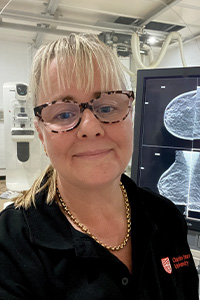
Behind Associate Professor Kelly Spuur’s work is a belief that women deserve better: better imaging, better access, and better chances of early detection. For over 30 years, she has combined clinical expertise with research leadership to tackle one of the most pressing challenges in women’s health: ensuring early, accurate detection of breast cancer for all.
“The better imaging we can do, the more likely we are to find breast cancer before it’s too late,” Kelly says. “It doesn’t matter how skilled the radiologist or surgeon or oncologist is – if the image isn’t right, we’ve already put that woman at a disadvantage.”
Kelly has turned a childhood fascination with bones into a career at the leading edge of radiographic diagnostics and mammography. Now an internationally recognised expert in her field, the Charles Sturt academic and Bachelor of Applied Science (Medical Imaging) graduate spent 16 years in clinical mammography before her frustration with outdated assessment systems led her to a PhD focused on image quality.
Her research there helped shape Volpara, a groundbreaking automated software platform enabling national and international benchmarking of image quality. By allowing radiographers to see their images in real time, it is a powerful educational tool that directly improves breast cancer detection.
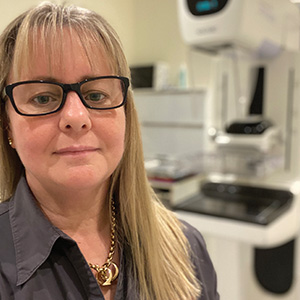 Kelly’s current research focuses on emerging Cone Beam Breast CT technologies developed in the US, which capture a true 3D image of the breast without compression or physical contact. It’s an exciting alternative to the limitations of 2D mammogram technologies, which are uncomfortable for many women and can obscure cancers due to overlapping or dense breast tissue.
She is particularly interested in the impact on women’s experiences, and the potential to boost screening rates among women who have experienced trauma, are culturally sensitive to touch, or are anxious about the process.
“One in seven Australian women will develop breast cancer before the age of 85, yet so many women put off having a mammogram for all these reasons and more,” she says. “With Cone Beam Breast CT, you’re lying on your stomach, you adjust your own top and drop your breast into the gap. There’s no handling of the breasts, no touching or compression, no standing around half undressed in front of someone you don’t know.”
It’s also good news for women in regional, rural and remote areas, who often face long travel or wait times to access screening.
“The unit is fully self-contained, and it’s a lot easier to set up and go than the current units. We can load it into a van or truck and go all around the country doing screening, including in vulnerable populations such as remote First Nations communities.”
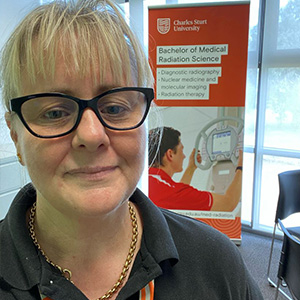 Kelly is also focused on building the future workforce needed to expand access to high-quality breast screening for every woman. She is particularly passionate about growing Charles Sturt’s Graduate Diploma of Mammography program, and its pool of talented alumni shaping public and private practice throughout Australia.
“We have a desperate need for workforce and it’s crucial to encourage more radiographers to specialise in mammography,” she says. “With the work we’ve done in this space, we’re now seeing students choose mammography earlier in their careers. That’s part of the legacy I want to create: a pipeline of skilled, passionate professionals to bring the best possible breast imaging and diagnostics experience to every Australian woman.”